
The short answer
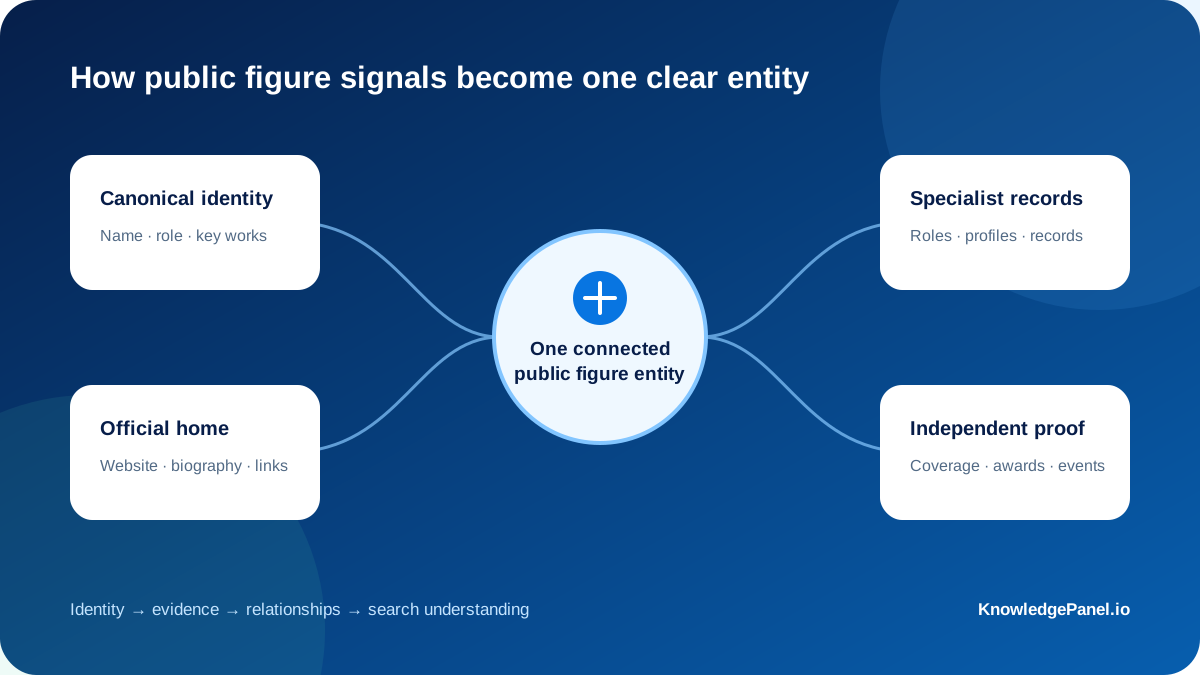
A public figure cannot submit an application that guarantees a Google Knowledge Panel. Google creates panels automatically from information available across the open web. The practical goal is to make one identity clear and corroborated: document stable facts, establish an authoritative home, connect legitimate platform records, publish accurate structured data, and resolve contradictions at their source.
Check your presence for freeHow Knowledge Panels work for public figures
Google describes a Knowledge Panel as an automatically generated summary of an entity—such as a person or organisation—based on its understanding of content available across the web. For public figures, the entity can be harder to resolve when names, roles, profiles, works, or organisations overlap.
No website, database, schema field, press placement, or agency controls Google’s final decision. Accurate evidence helps systems interpret the subject; it does not buy or unlock a search feature. If a panel appears, the subject or an authorised representative may be able to claim it and suggest evidence-backed corrections through Google’s official workflow.
Publishing more pages cannot compensate for two sources describing different people, roles, dates, or works. Correct the most authoritative source first, then let connected pages reinforce the same facts.
The practical process
Seven steps to strengthen a public figure entity
Define the canonical identity
Create a fact register with a source and review date for every sensitive biographical claim.
Establish an authoritative home
Separate current positions, former positions, candidacies, honours, and advisory roles.
Align specialist records
Use authorised, high-resolution images with clear ownership and descriptive context.
Publish accurate structured data
Connect the person to institutions without presenting institutional claims as self-authored facts.
Build independent corroboration
Correct conflicting dates and titles at authoritative sources before amplifying them elsewhere.
Connect entity relationships
Prepare evidence URLs before submitting panel feedback.
Monitor, claim, and correct
Define who in the team may verify, monitor, and suggest changes.
1. Create a canonical fact register
Begin with a source-backed record of full public name, roles, dates, affiliations, nationality or location where relevant, official appointments, and notable work. For every fact, record the preferred wording, a reliable source URL, who owns the correction, and the last review date. This prevents a website update from creating new conflicts elsewhere.
Search the public name with role, location, organisation, and important-work qualifiers. Note same-name entities, outdated biographies, duplicate profiles, incorrect images, and mismatched dates. Resolve ambiguity with evidence rather than keyword repetition.
2. Build the official identity hub
The strongest owned foundation is an official biography with dated roles, a clear representative contact, authorised photographs, speeches or work, and links to verified accounts. The page should identify the subject immediately, use a stable canonical URL, and link only to profiles and organisations that genuinely belong to the entity.
- Put essential facts in crawlable HTML.
- Use descriptive page titles, headings, links, and image alternatives.
- Maintain a visible updated date for facts that change.
- Redirect retired canonical pages rather than abandoning their authority.
- Keep biography and contact information accessible on mobile.
3. Align the records specific to public figures
Generic social profiles are only one layer. Review official institution pages, government or organisation biographies, verified profiles, event records, ProfilePage where appropriate, and accurate Person markup. Correct duplicate, merged, or misattributed records through each platform’s supported process.
Do not create accounts or database entries merely to fill a checklist. A record is useful when it is legitimate, maintained, relevant to the profession, and capable of supporting a fact without contradicting stronger sources.
4. Add structured data that matches visible content
Use the most accurate Schema.org type for the page and subject. For this guide, Person is the usual starting point, but more specific types and relationships may apply. Google recommends using accurate author or organisation types and valid URLs that uniquely identify the entity.
{
  "@context": "https://schema.org",
  "@type": "Person",
  "name": "Preferred public name",
  "url": "https://official.example/",
  "description": "Accurate visible description",
  "sameAs": ["https://relevant-platform.example/profile"]
}
Only include facts and links that visitors can verify. Validate the rendered page and remember that valid markup does not guarantee a Knowledge Panel or rich result.
5. Build independent corroboration
Owned pages describe the subject’s position. Independent sources test whether other credible organisations recognise it. Relevant evidence for this niche includes high-quality reporting, official registers, institutional archives, recognised awards, interviews, and reputable biographical references.
Evaluate every source for editorial independence, specificity, factual depth, permanence, and relevance. Ten copied announcements do not provide the same corroboration as one detailed, independently reported profile.
6. Connect relationships without merging entities
Map the subject to works, employers, companies, publications, collaborators, events, and official profiles. Each connected object may be its own entity. Describe the relationship explicitly and use stable URLs so machines do not have to infer whether two names refer to the same thing.
Review the public figure service page for the signal categories used in our public-source assessment.
7. Monitor, claim, and correct
Keep a dated snapshot of relevant searches and the sources supporting important facts. Recheck after substantive website, profile, publication, or role changes—not simply every day. When an eligible panel can be claimed, use Google’s verification process. Submit corrections with a concise explanation and reliable evidence URLs.
KnowledgePanel.io planning framework
The four-layer evidence stack
This framework organises work; it is not a Google score, eligibility test, or forecast.
Identityfull public name, roles, dates, affiliations, nationality or location where relevant, official appointments, and notable work
Owned authorityan official biography with dated roles, a clear representative contact, authorised photographs, speeches or work, and links to verified accounts
Platform alignmentofficial institution pages, government or organisation biographies, verified profiles, event records, ProfilePage where appropriate, and accurate Person markup
Independent corroborationhigh-quality reporting, official registers, institutional archives, recognised awards, interviews, and reputable biographical references
A 20-point evidence inventory
Score each category from 0 to 4 using evidence available today. The total is an internal completeness measure, not Google’s score.
A practical 30/60/90-day plan
Audit and correct
Build the fact register, identify same-name conflicts, repair the official hub, and prioritise factual corrections at authoritative sources.
Connect the evidence
Align specialist records, implement valid markup, consolidate profile links, and document entity-to-work or entity-to-organisation relationships.
Strengthen and monitor
Develop legitimate independent evidence, review search presentation, preserve snapshots, and use official verification or feedback tools where available.
This is an operational sequence, not a promise that Google will create or update a panel within 90 days.
Common mistakes to avoid
- Leaving former roles presented as current.
- Publishing unsourced honours or titles.
- Using inconsistent dates across official biographies.
- Allowing representatives to create competing profiles.
- Submitting panel corrections without evidence.
- Confusing a political campaign, office, and person.
Frequently asked questions
Can a public figure create a Knowledge Panel directly?
No. Google generates knowledge panels automatically from information found across the open web. If a panel is available to claim, the subject or an authorised representative can follow Google’s verification process.
Does structured data guarantee a panel?
No. Accurate structured data can clarify what a page describes, but Google does not guarantee any search feature even when markup is valid.
How long does the process take?
Google publishes no fixed timeline. Crawling, identity ambiguity, source quality, public prominence, and changes across the web can all affect discovery and presentation.
Who should claim the panel?
The subject or an authorised representative should follow Google’s verification flow and maintain clear internal ownership of the verified account.
Can an incorrect panel be edited directly?
Verified representatives can suggest changes, and other users can submit feedback. Google reviews the evidence and controls the final display.
Sources and further reading
Start with evidence